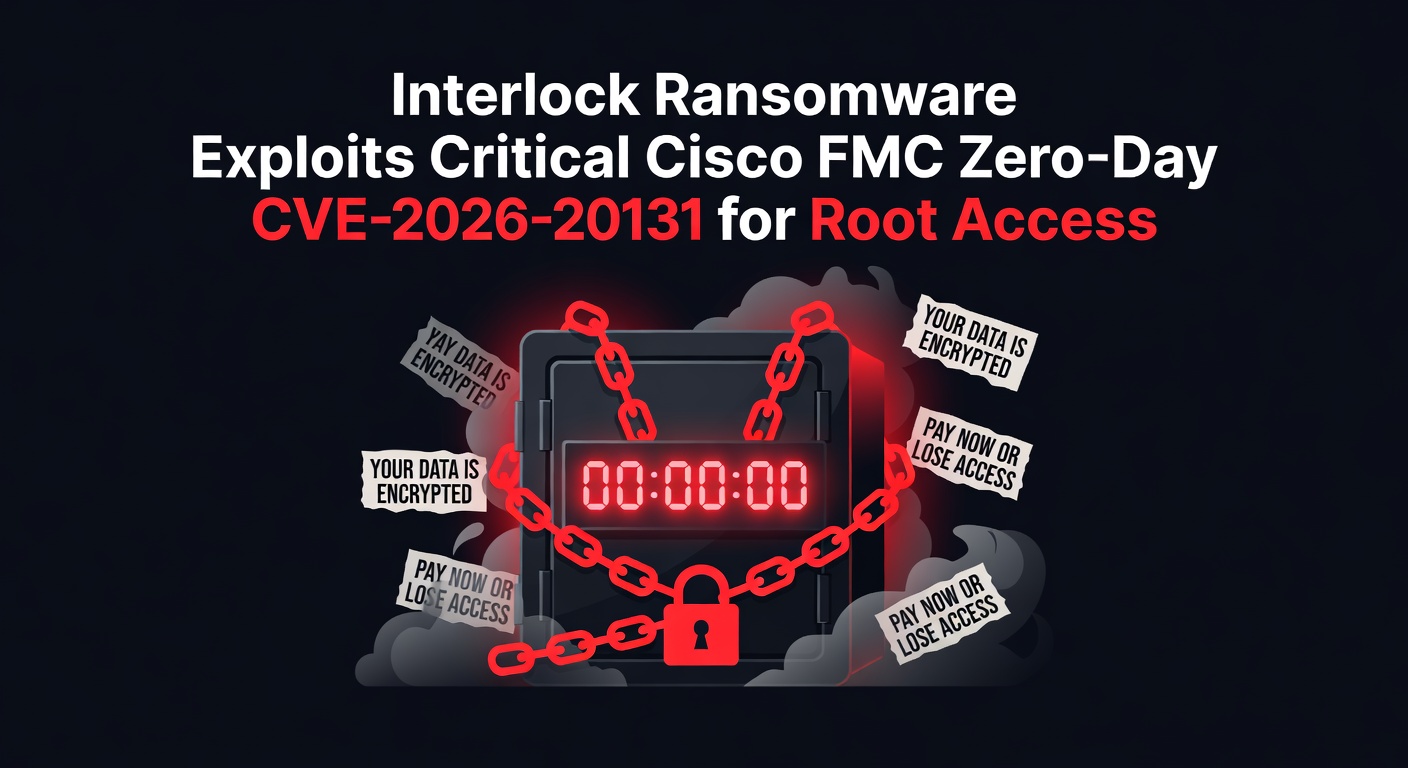
Interlock Ransomware Exploits Critical Cisco FMC Zero-Day CVE-2026-20131
By NewsNukem Cybersecurity Team | March 2026
Amazon Threat Intelligence has issued an urgent warning about an active Interlock ransomware campaign exploiting a critical zero-day vulnerability in Cisco's Secure Firewall Management Center (FMC) Software. The vulnerability, designated CVE-2026-20131, carries the maximum CVSS score of 10.0 and could allow an unauthenticated, remote attacker to execute arbitrary code on an affected system.
Background: A Perfect Storm of Vulnerabilities
The Interlock ransomware group is a threat actor targeting enterprise infrastructure. This campaign involves the exploitation of a zero-day vulnerability in a critical network security appliance, a method that differs from more common ransomware tactics like phishing or credential theft.
Cisco's Secure Firewall Management Center serves as the centralized management platform for Cisco's next-generation firewall solutions, making it a high-value target for cybercriminals. Organizations worldwide rely on FMC to manage security policies, monitor threats, and coordinate incident response across their network perimeters.
The timing of this exploitation campaign is particularly concerning, as CVE-2026-20131 was only recently disclosed, giving organizations minimal time to patch their systems before active exploitation began.
Technical Analysis: Understanding CVE-2026-20131
CVE-2026-20131 represents a textbook case of insecure deserialization, a vulnerability class that has plagued Java-based applications for years. The flaw exists within the FMC software, where user-supplied Java byte streams are processed without proper validation or sanitization.
The vulnerability occurs when the FMC software deserializes untrusted data. An attacker can craft malicious serialized Java objects that, when processed by the vulnerable deserialization routines, can execute arbitrary code.
The attack vector requires no authentication, making it particularly dangerous. Attackers need only network access to the FMC's management interface to exploit the vulnerability. The insecure deserialization occurs before any authentication checks, allowing completely external attackers to compromise systems.
Real-World Impact and Attack Methodology
Amazon Threat Intelligence's analysis reveals that Interlock operators have weaponized CVE-2026-20131. The campaign involves exploiting the vulnerability to compromise systems and deploy ransomware.
Perhaps most concerning is the strategic value of compromising firewall management systems. These platforms contain detailed information about network architecture, security controls, and potential vulnerabilities—intelligence that significantly enhances an attacker's ability to maintain persistence and evade detection.
How to Protect Yourself
Immediate Actions:
- Apply Cisco's emergency patch for CVE-2026-20131 immediately if available
- If patches aren't yet available, consider temporarily isolating FMC systems from internet access
- Review FMC access logs for suspicious activity, particularly focusing on REST API endpoints
- Implement network segmentation to limit potential lateral movement from compromised FMC systems
Long-term Security Measures:
- VPN Protection: Use enterprise-grade VPN solutions to secure remote access to critical infrastructure. Never expose management interfaces directly to the internet
- Zero Trust Architecture: Implement zero trust principles requiring authentication and authorization for all network access, even to management systems
- Regular Security Assessments: Conduct quarterly penetration testing focusing on management interfaces and deserialization vulnerabilities
- Monitoring and Detection: Deploy advanced monitoring solutions to detect unusual network traffic patterns and unauthorized access attempts
Backup and Recovery:
- Maintain offline, immutable backups of critical configurations and data
- Regularly test backup restoration procedures
- Consider implementing backup encryption to protect against data theft
Industry Response and Future Implications
The cybersecurity community has responded swiftly to this threat.
This incident underscores the critical importance of securing network infrastructure components and highlights the growing sophistication of ransomware operations. The rapid weaponization of zero-day vulnerabilities by criminal groups represents an evolving threat landscape where the window between disclosure and exploitation continues to narrow.
Organizations must adopt a more proactive security posture, including regular vulnerability assessments, network segmentation, and robust incident response capabilities. The days of treating network security appliances as "set and forget" infrastructure are long gone.